x
x
x
x
A Tale of Two Towers
At first glance, Wheaton College in Wheaton, Illinois, and Fermilab National Accelerator Laboratory in Batavia, Illinois, share few points of commonality; but a closer examination reveals otherwise.
Wheaton College (est. 1860) and Fermilab (est. 1967) were intentionally situated on the largely undeveloped prairie about thirty miles west of Chicago for convenient access by cross-country traffic.
Both institutions employed talented veterans of the classified Manhattan Project, which eventually ended WW II. Dr. Robert Rathbun Wilson (1914-2000), Fermilab’s first director and guiding visionary, served as the head of R (Research) Division at Los Alamos, New Mexico, under the supervision of Dr. J. Robert Oppenheimer, the “father of the atomic bomb.” Similarly, Dr. Roger Voskuyl (1910-2005), professor of Chemistry at Wheaton College and later president of Westmont College in Santa Barbara, California, served as a group leader for the top-secret mission.
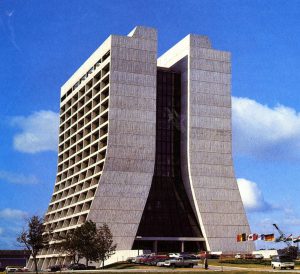
Administrative and academic activities for both campuses revolve around iconic loci featured on signage and letterhead. Fermilab’s Wilson Hall, aesthetically influenced by the gifted architect Robert R. Wilson, dominates the landscape at sixteen stories. The upward sweep of its outer walls, somewhat resembling praying hands, purposely evokes the Beauvais Cathedral in France, the most daring Gothic undertaking of the 13th-century.
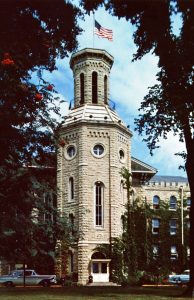
Wheaton College’s neo-Gothic main building, Blanchard Hall, recalls structures admired by founder and first president Jonathan Blanchard during a European journey.
While Jonathan Blanchard was a rock-ribbed Yankee who protected escaped slaves via the Underground Railroad, Robert Wilson was a proud descendant of abolitionist John G. Fee, founder of Berea College, a school for blacks and whites in pre-Civil War Kentucky. Wilson also actively recruited people of color to work at Fermilab during the Civil Rights Movement.
Fermilab’s staggeringly complex machinery, particularly DUNE (Deep Underground Neutrino Experiment), is extensively networked beneath the farmland of Batavia, while the sandstone blocks used to construct Blanchard Hall were cut from a quarry in Batavia.
Both institutions boast pretty good cafeterias.
A herd of buffalo, brought by Wilson to recall his beloved childhood home in Wyoming, graze the high grasses on a ranch at Fermilab, while a gaggle of haughty geese strut freely through the manicured acreage of Wheaton College.
Fermilab educates students, scientists and engineers from all over the world. Likewise, globally minded Wheaton College prepares international missionaries, teachers, pastors and other workers, fulfilling Christ’s Great Commission: “Go therefore and make disciples of all nations, baptizing them in the name of the Father and of the Son and of the Holy Spirit, teaching them to observe all that I have commanded you. And behold, I am with you always, to the end of the age” (Matthew 28:19-20).
As Dr. Leon Lederman, the Nobel Prize winning second director of Fermilab, observes, the U.S. Department of Energy research facility investigates with perpetual wonder and perplexity the subatomic conundrums posed by “inner space, outer space, and the time before time.” Exploring multidimensionality from a literary vantage, Wheaton College displays a wardrobe owned by British author C.S. Lewis, which modeled the magical doorway into Narnia. In addition, the Christian liberal arts college archives the papers of Madeleine L’Engle, who wrote A Wrinkle in Time, about a perilous trek through the centuries. In fact, her award-winning science fantasies were inspired by papers published by theoretical physicists Albert Einstein, Max Planck and Niels Bohr.
And despite the efforts of the finest minds and the most sophisticated instrumentality, the comprehensive “theory of everything,” the invisible energy field that holds the universe intact, remains frustratingly elusive. “The universe is the answer,” laments Lederman in The God Particle (1993), “but damned if we know the question.”
If one imagines an anthropomorphized Wilson Hall crying out the plaintive inquiries of a puzzled quantum physicist to the starry cosmos, then Blanchard Hall, standing only ten miles away, simply responds to that plea with Hebrews 1:3, “[Jesus] is the radiance of the glory of God and the exact imprint of his nature, and he upholds the universe by the word of his power.”
Red Grange: The Life and Legacy of the NFL’s First Superstar by Chris Willis
In an age of superstar athletes, Harold “Red” Grange (1903-1991) stands among the greatest, embodying the spirit of honest sportsmanship and American achievement. Chris Willis’ Red Grange: The Life and Legacy of the NFL’s First Superstar (2019) chronicles the rise of the humble football player from his first job delivering ice blocks in Wheaton, Illinois, to performing immortal exploits on the gridiron, to his brief acting career in Hollywood, and finally his role as the esteemed elder statesman for the National Football League. 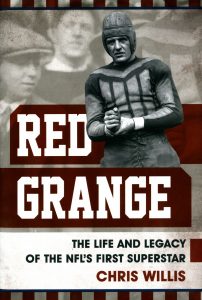
Consulting an array of resources, including the Red Grange Papers (SC-20) at Special Collections, Buswell Library, Wheaton College, Willis offers a fresh perspective on the beloved coach, broadcaster, pitchman, Hall of Famer and ambassador.
Chris Willis is head of the research library for NFL Films. His books included The Man Who Built the National Football League: Joe F. Carr (2010); Dutch Clark: The Life of an NFL Legend and the Birth of the Detroit Lions (2012); and The Inside Story of the 1984 San Francisco 49ers (2014). He was nominated for an Emmy in 2002 for his work on the HBO documentary The Game of Their Lives: Pro Football’s Wonder Years and won an Emmy in 2016 for his work on HBO’s Hard Knocks: Training Camp with the Houston Texans.
Leighton Ford at Wheaton College
Dr. Leighton Ford is President of Leighton Ford Ministries, preparing younger leaders to spread the gospel of Christ to a needy world. From 1955 until 1985 he served as Associate Evangelist and later Vice President of the Billy Graham Evangelistic Association. Ford’s ties with Billy remained strong throughout the decades.
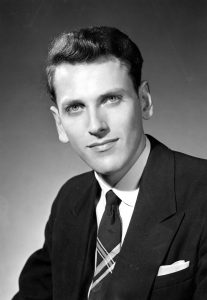
Not only were they eventual brothers-in-law, but the renowned evangelist, preaching at a 1949 Youth for Christ rally in Chatham, Ontario, suggested to young Leighton that he consider attending Wheaton College near Chicago instead of Knox College in Toronto. Persuaded, Leighton packed his bags and headed south to the Land of Lincoln. Biographer Norman B. Rohrer relates a few episodes from Leighton Ford: A Life Surprised (1981):
The gray Oldsmobile was loaded for the trip that would take Leighton to Illinois, farther from home than he had ever traveled. Mrs. Ford insisted on going along and further embarrassed her son by renting an apartment near the campus to keep an eye on him…All who entered with Leighton in 1949 signed a pledge of total abstinence from tobacco, liquor, and movie-going. Mrs. Ford, watching from her post off-campus, found the movie ban curious. Her austere conservatism could match anybody’s, but she had not struck movies off her list of permissibles. She tugged occasionally on the apron strings from her watchtower while Leighton tried to keep her clinging presence a secret.
Wheaton [College] was a daily serendipity for the young preacher. His room was only a few blocks from the international headquarters of Youth for Christ where his heroes came and went. Gil Dodds, world champion indoor miler, was Wheaton’s track coach; a school friend named Bill Davies was the brother of internationally famous basketball star Bob Davies, who had embraced the Christian faith.
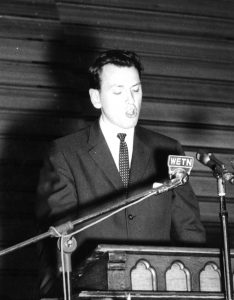
Many thought that Leighton had copied Billy Graham’s style of preaching. The similarities were explainable: both were tall (Leighton nearly an inch taller than Billy) and thin (Leighton runs ten pounds lighter than his brother-in-law but is an inch broader in the shoulders). Both have the same vocal characteristics. Both have expansive gesticulation, a commanding voice, an urgency of theme. And both were caught up in the fervor of the new Youth for Christ movement that demanded such a flamboyant style.
In 1951 Leighton became a candidate for student body president during his senior year. He persuaded a reluctant Sam Befus to manage his campaign and the stage was set. For buttons blossomed. His campaign slogan was: “There’s a Ford in your future.” Posters showed a boy and a girl — the girl poised for a kiss, the boy admiring instead a passing Ford car. It was the wrong poster for conservative Wheatonites in the early fifties.
Leighton’s nimble mind was a seedbed for the postulations of such professors as Merrill Tenney, Arthur Holmes, Kenneth Kantzer and Clarence Hale….Leighton was qualified to enter upon his college major of philosophy. He proved it by graduating with the highest score on his comprehensive examinations of all other students in Wheaton’s 92-year history.
Leighton Ford is the author of several books, including Sandy: A Heart for God, chronicling the unexpected death of his son. His autobiography, A Life of Listening: Discerning God’s Voice and Discerning Our Own, was released by InterVarsity Press in 2019.
Dr. George “Bud” Williams, Leader, Friend and Gentleman
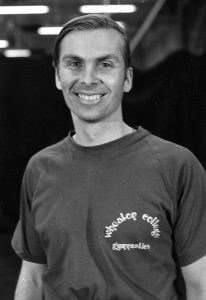 Like any good soldier, Dr. George “Bud” Williams (1942-2019) performed all assigned tasks with exactitude and energy. He studied at Penn State and was accepted (but did not attend) Yale University. Excelling in gymnastics, he served as Instructor in Physical Education and Coach at West Point Military Academy. He commanded an ROTC battalion, and taught various aspects of health and athletics at Wheaton College, stressing the necessity for nutrition, hygiene and spiritual renewal.
In addition to his academic responsibilities, Bud acted as president of the Christian Society for Kinesiology and Leisure Studies, and served on the board of Christian Camping International (SC-55), envisioning the digitization of its archived documents for the benefit of international missions research. He particularly relished his visits to Honey Rock Camp, where he subsequently established the Vanguard program, developing Wheaton College student leadership amid the unpredictability of outdoor activities. He describes the purpose of Vanguard in a 1975 manual:
Vanguard is essentially a series of personal and group initiative tests that require the person to think creatively and rationally, often under the pressure of time and circumstances. Through many of the tasks the individual or group is presented with problems that they must solve, from dividing and cooking food, setting up camp, navigating a map and compass through dense forest, to performing service projects, and many other such challenges.
Above all else, Bud loved his Savior.
Flashing a gleaming smile and quick blue eyes, intense but approachable, he radiated a warmth that netted generations of loyal friends among staff, faculty and students; but underneath the kindly demeanor lay a driving desire to improve himself and those with whom he interacted.
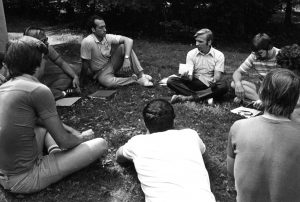 Bud was committed to the formation of a hardy but sensitive moral character stabilized and nourished by the Spirit of God, and constantly sought resources that would inculcate this principle to his classes, indoors or out. He knew that when the man or woman securely rooted in Christ passed from the scene, a lingering force of integrity, a wide-ranging, life-giving testimony should remain, ever attracting a fallen humanity to the risen Savior.
Bud has passed, but his influence echoes with the resonance of morning reveille through the hearts of those he taught and loved.
Worthwhile Struggle by Pat McCaskey
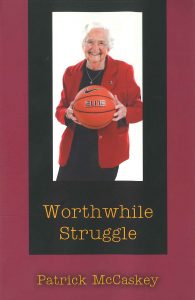 Worthwhile Struggle by Patrick McCaskey features a grab bag of inspirational stories woven with tales of exemplary athletes. Included are McCaskey’s “10 Commandments of Football,” based on his upbringing in the Halas-McCaskey family with the Chicago Bears. Deeply involved with faith-based initiatives and charitable causes, McCaskey is active in promoting strong principles and honest gamesmanship.
In the chapter titled “Oswald Chambers,” McCaskey briefly highlights the life and ministry of the great Scottish preacher, including a photo of Chambers with his wife, Biddy, and their baby daughter, Kathleen. The image is archived in Special Collections, Buswell Library, Wheaton College (SC-122)
McCaskey also profiles his friend, Wayne Gordon, who graduated from Wheaton College in 1975, and currently serves as the pastor of influential Lawndale Community Church. “You won’t see Coach Wayne Gordon’s name in the headlines or his face on television,” writes McCaskey. “And yet, he has been one of Chicago’s movers and shakers for over 40 years…He is about selflessly helping others get a fair shake, helping others succeed, helping others build their own healthy community, and helping others to live faithfully.”
Pat McCaskey is a Board Member and Vice President for the Chicago Bears. Encouraged by his grandfather, George Halas, he attended DePaul University, where he earned his master’s degree. He is the author of six books.