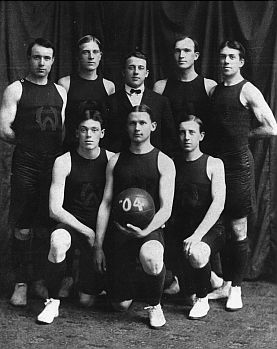
 As Wheaton College begins its 2008-2009 basketball season the history of Wheaton’s basketball program should be remembered. The first time basketball appeared in the Olympics was 1904, held in Saint Louis, Missouri and was held as a demonstration sport and not for any medals. Four different levels of competition were held with Wheaton College participating in the College-level along with Hiram College and Latter Day Saints University (which no longer exists).
Of Wheaton’s intercollegiate sports, basketball has the longest consecutive record with competition occurring since 1901. The game had been invented only nine years earlier by Dr. James Naismith, an instructor in the YMCA College in Springfield, Massachusetts. Wheaton’s strong connection with the YMCA helped foster the adoption of this sport at the college. In 1899 the first Wheaton College gymnasium was built with a playing floor of 77 ft. by 36 ft. compared to the contemporary 94 ft. by 50 ft.  It was one of the finest gymnasiums in existence in the state at the time. Additionally, because of the quality of the facilities and its proximity to Chicago Wheaton became one of the first colleges to have varsity teams.
In 1904 Wheaton was invited to participate in the national college basketball tournament at the World’s Fair and Olympics in St. Louis, achieved by compiling the best winning percentage of any college in Illinois. The Olympics were originally to be held in Chicago but were combined with the Louisiana Purchase Exposition after extensive political wrangling.
The Wheaton team took second place to Hiram College of Ohio.
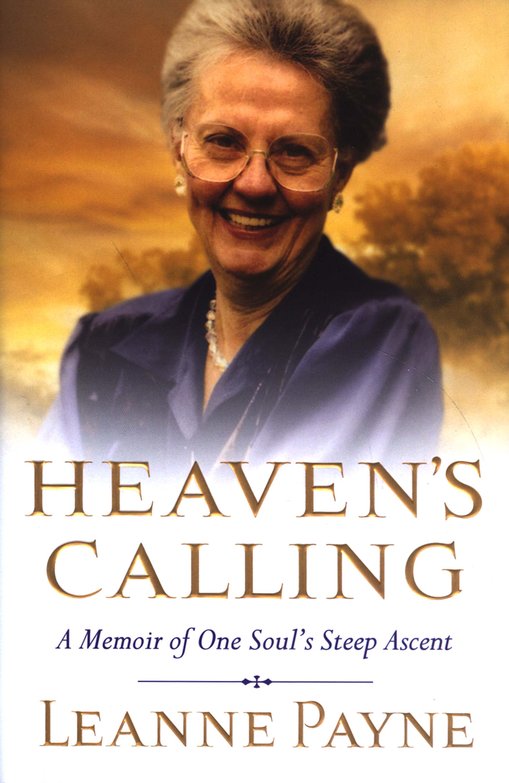 Leanne Payne’s autobiography, Heaven’s Calling: A Memoir of One Soul’s Steep Ascent (2008), unfolds the ever-rolling road of an extraordinarily rich and adventurous faith-life, moving gracefully from her childhood to her years as a student at Wheaton College, and finally to her role as author and founder of
 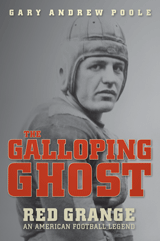 Harold E. “Red” Grange is the most important figure in American football history. In 1924, playing for the University of Illinois, he scored four touchdowns in 12 minutes against Michigan. And so Grange, nicknamed “the Galloping Ghost” by Chicago sports writer Warren Brown, forever secured his reputation as a gridiron legend. Grange dazzled fans, inspired poetry, starred in films, and was the first celebrity product endorser. In 2008 he was ranked #1 on ESPN’s Top 25 Players in College Football History list. But who was the nation’s first football hero? From barnstorming tours to stadium rallies, from the White House to Hollywood, Gary Andrew Poole’s The Galloping Ghost, the first critical biography of “Red” Grange, chronicles the meteoric rise of this extraordinary athlete. Drawing on extensive research and interviews, Poole details not only Grange’s relationship with Bears manager George Halas and his later life as motivational speaker and tv sports commentator, but he also touches on the shadowy aspects of 1920s sports management, exploring the influence of Grange’s agent, the visionary but unscrupulous C.C. Pyle, known then as “Cash-and-Carry Pyle” and now as “the first Jerry Maguire.” The Galloping Ghost is an energetic, perceptive account of a star athlete who defined the finest qualities of American sportsmanship.