All posts by admin

Through the Eyes of a Child – Sesquicentennial snapshot

The following comments by Charles Blanchard, who would have been 12 years-old when his father, Jonathan, assumed the presidency in 1860, are taken from David Maas’ Wheaton College Awakenings, 1853-1873.

“That fall [1860] I entered the academy, and my father being president of the institution, of course I was in touch with all college affairs. The home in which we lived was a small house one block south of the southwest corner of the campus, now owned and occupied by Mr. E.P. Webster, an alumnus. It is, as all who know it will remember, a very small house. My father had his study in the college building. There was only one building then and it was a very small part of what the central building is now. My father’s study was in the southwest corner. On the floor there were four class rooms. The college library was in my father’s office, and there was ample room for it there. I remember that when I was a child my father frequently wrote very late at night and that a light from his office window shown out in the dark.

My father’s life in the college was as my own has been. He taught the seniors and gave himself afternoons, Saturdays, Sabbaths, summer and winter, to the outside interests of the college. In this way funds were secured and students were attracted.”

Wheaton College, 1860“We, that is, the family, arrived in Wheaton on an April day in the year 1860. The thunder of the guns about Fort Sumter was only a year away yet there was no hint of that dread concert in the air or the earth of that April morning. As already intimated the town was unspeakably dreary. The cold damp of the spring rains, the low marshy grounds the inferior huddle of houses, the single college building standing alone in the midst of its campus, the boarding house at the foot of the hill, cheaply constructed altogether was wearisome and dreary.

My father had been at work since the preceding January. I marvel now as I think of his faith and courage and cheer as in those unfavorable circumstances, with almost no resources, he pushed on the work of empire-building. Not a material empire but a spiritual kingdom founded in the soul of men, to outlast the mountains and the stars.”

“Zeroes for each of you” – Sesquicentennial snapshot

In his memoirs The Wheaton I Remember, Edward “Coach” Coray (Professor Emeritus and former Executive Director of the Alumni Association) recalls his first days as an undergraduate student at Wheaton College in the Fall of 1919.

Our first class was rhetoric and we sat in chairs around the sides of the room. Professor Straw took roll peering at each student over the top of his glasses. Then he read Scripture and offered prayer. Next he startled a member of the class by calling on her to sing a hymn. In the days which followed members of the class read Scripture and offered prayer and each took his turn at singing. From an aesthetic standpoint the music was not always top quality.

The first day’s devotions having ended, our teacher instructed us each to take a section of the blackboard and summarize the first chapter of the text. My friends and I kept our seats. Professor ambled over, faced us, looked us over and said, “What’s the matter with you boys?” We explained to him that we had tried to buy textbooks but the supply had run out, that we did have a real thirst for knowledge and that the situation was one which caused us much sorrow. Rather than bring tears to his eyes Prof gave us a cold look and said, “Shame on college men who are not more resourceful than that. You should have borrowed a book or used the one in the library. Zeroes for each of you.” Whereupon he took his gradebook, made sure of our names and started each of our college careers with a big fat zero.

Woman’s Christian Temperance Union

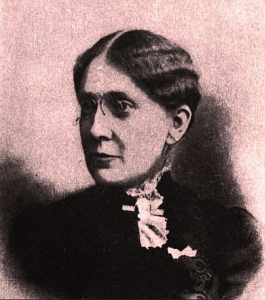
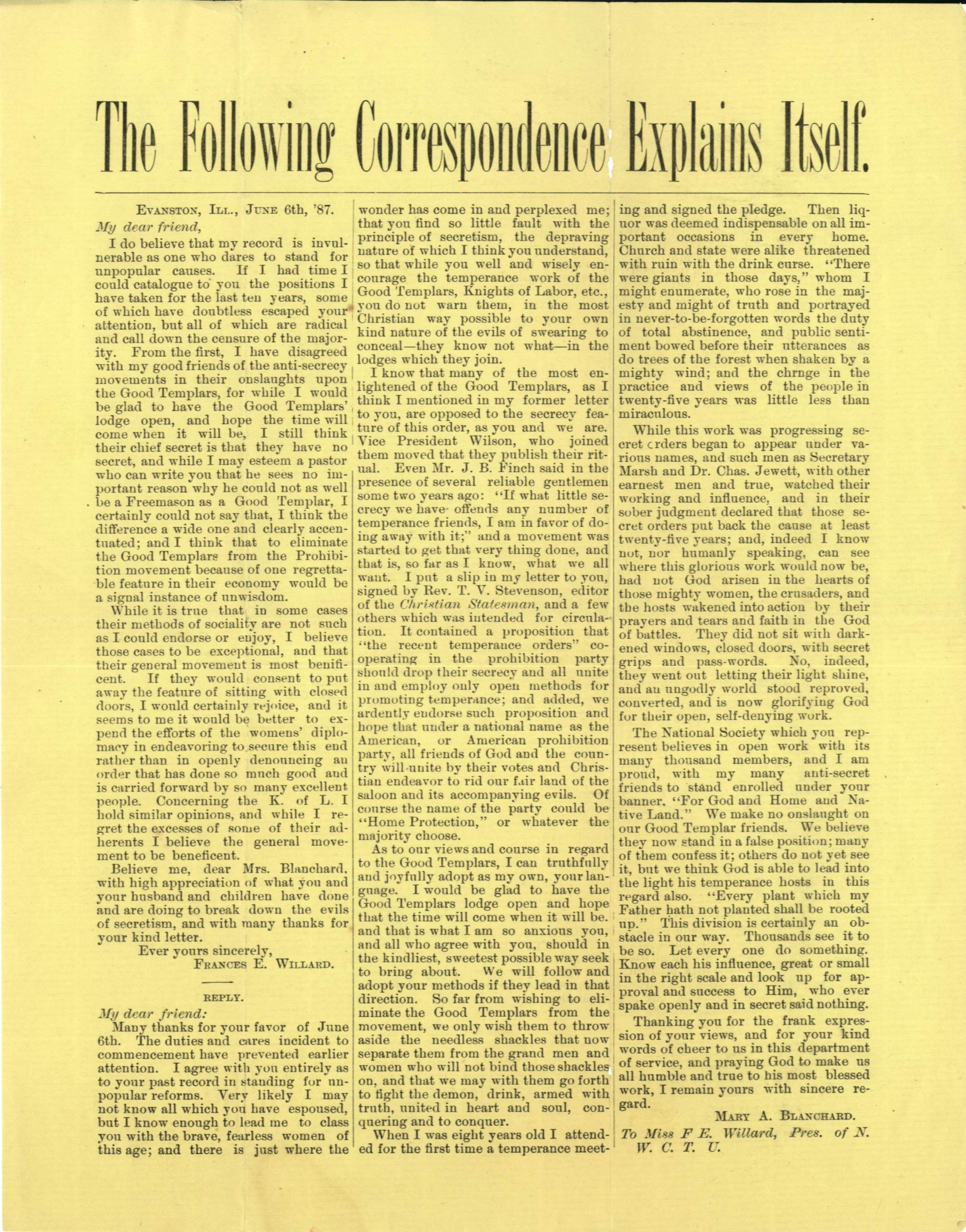
Frances WillardThis summer marks the 135th anniversary of the founding of the Woman’s Christian Temperance Union. Beginning in the fall of 1873 many women across Ohio and New York gathered in churches and marched at their local saloons in support of temperance. After listening to lectures by Dr. Diocletian “Dio” Lewis, groups in Fredonia, NY and Hillsboro and Washington Court House, Ohio protested against alcohol and decided that a national organization was necessary. In August 1874 at an interdenominational meeting of the National Sunday School Assembly held on the Chautauqua Grounds at Lake Chautauqua, NY, a national convention was planned for later that fall. On November 18-20, 1874, women from eighteen states gathered in the Second Presbyterian Church in Cleveland, Ohio to organize the first national convention of the National Woman’s Christian Temperance Union (WCTU). During this three day meeting, methods, plans of work, a pledge and constitution were formulated and the first set of officers was elected.

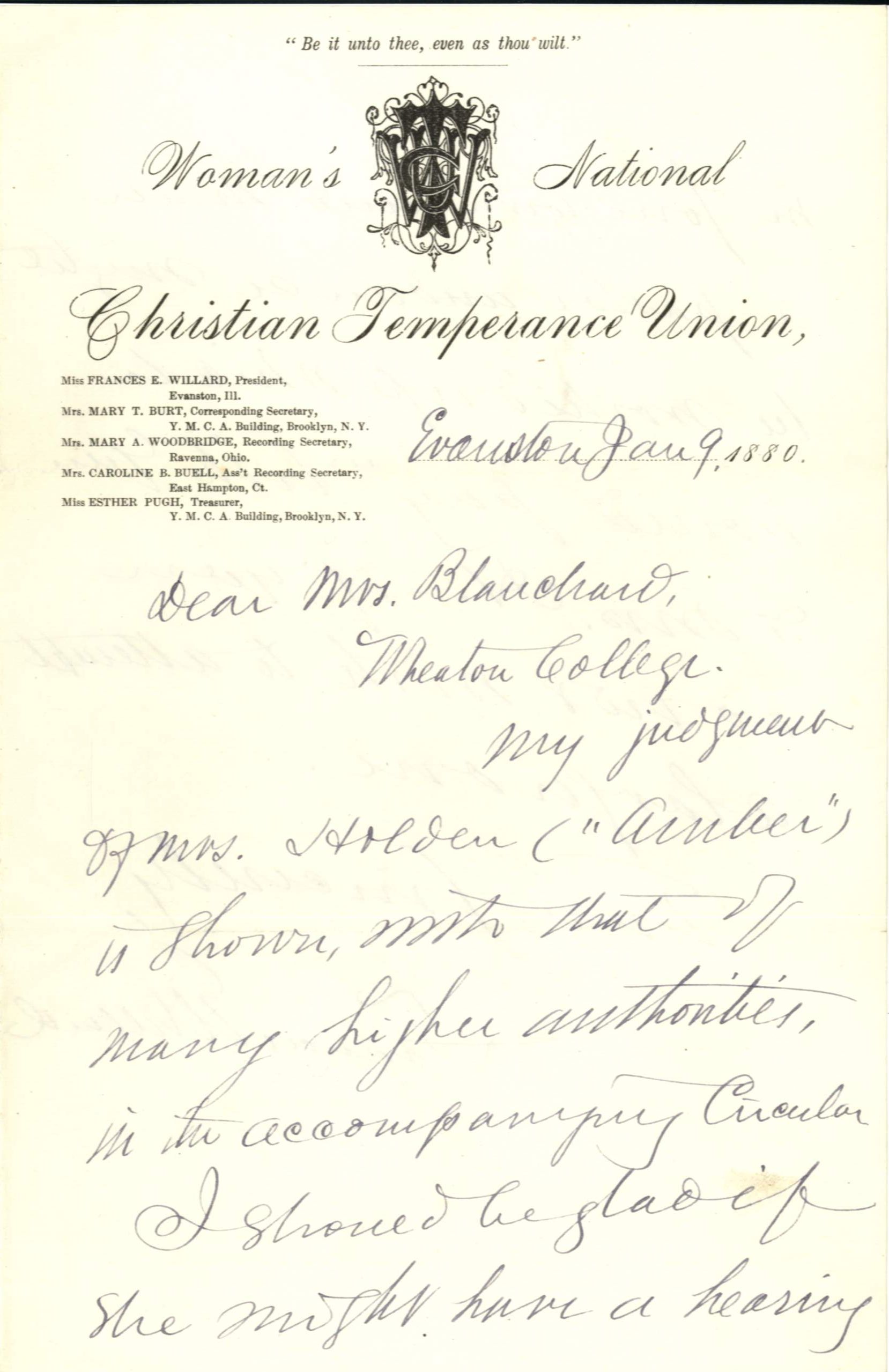
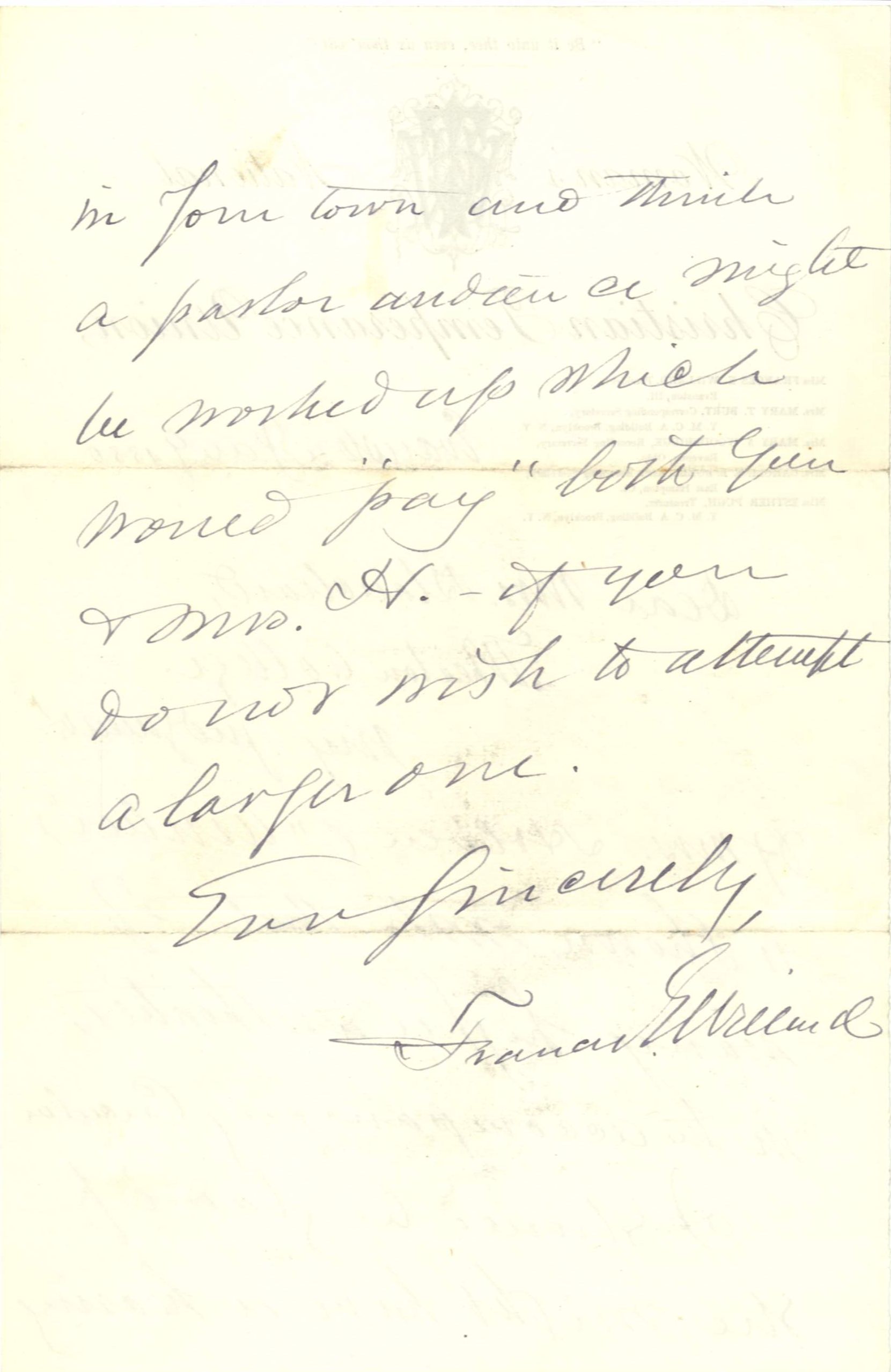
LetterLetter

In 1879 Frances Willard became president of the WCTU and used her political prowess and moral persuasion in championing total abstinence. As president of the Woman’s Christian Temperance Union from 1879 to 1898, she garnered support for temperance as well as women’s suffrage, economic and religious rights, prison reforms, abstinence, education and labor reforms, and international peace. Willard’s personal motto was “do everything.” The WCTU adopted this as a policy which came to mean that all reform was interconnected and that social problems could not be separated. The use of alcohol and other drugs was a symptom of the larger problems in society such that by 1896, over two dozen of the WCTU’s departments were dealing with non-temperance issues. The WCTU would become the oldest continuing non-sectarian women’s organization in the world and continues to this day.

Leaflet

According to Howard A. Snyder’s “Populist Saints” (Eerdmans 2006), Wheaton College president, Jonathan Blanchard met with Francis Willard and other WCTU leaders in an attempt at joining forces, but an alliance was not forged due to WCTU ties with the Knights of Labor and Good Templars. A Wheaton chapter of the Woman’s Christian Temperance Union was eventually formed and it’s records lie in the Special Collections and are composed of meeting minutes from 1906-1956. The College Archives also holds correspondence between Frances Willard and Jonathan’s wife, Mary Bent Blanchard, some of which was published in the Christian Cynosure newspaper.

Two houses, both alike in dignity…

Wheaton College is widely recognized for its endeavor to integrate faith and learning, so it is somewhat surprising to discover that there was a moment when its administration stoutly resisted the implementation of a theater program. It may also come as a surprise for some to learn that another Christian liberal arts college, Bob Jones University, pursued drama as a valid educational discipline decades before Wheaton.
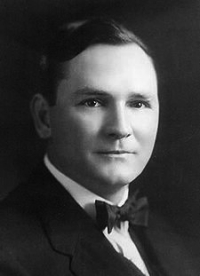
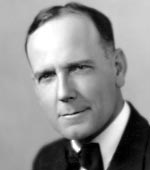
Bob Jones, Sr.Bob Jones College (now University) was founded in 1927 in College Point, Florida, by Methodist revivalist Dr. Bob Jones Sr. He determined that this institution defy the mockery of the day. “This college,” he said, “was founded [to] neutralize in this country the idea that if you are conservative and believe the Bible, that you are a sort of fanatic, or you’re lopsided or something. Some people – worldly, highbrowed, snooty people – think that if you’re a Christian, you’re queer…So we wanted to build a college that would neutralize in the minds of the public the idea that culture does not go hand in hand with the old-time conservative, Christian approach, and so we started off on that basis.”
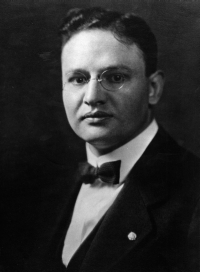
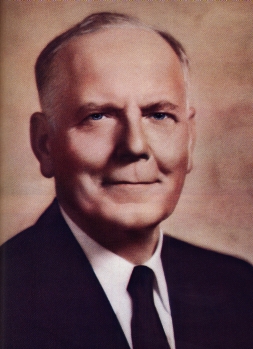
J. Oliver BuswellBut the appearance of Bob Jones College on the Christian educational scene was not welcomed by all within the conservative community. Most notably, J. Oliver Buswell, third president of Wheaton College, publicly objected, stating, “One [orthodox school] is enough. We ought to stay by that.” He added that, “Wheaton was doing everything that needed to be done.” Jones ignored Buswell and forged ahead. With its student body expanding amid the modernist/fundamentalist controversies of the 30s and 40s, the college moved from Florida to Cleveland, Tennessee, and finally to its present location in Greenville, South Carolina.

Occasionally Wheaton and Bob Jones College attempted to cooperate, but these efforts often failed. For instance, in 1929 Buswell and other Christian educators tried to convince Jones to join their fight against educational standardization. Jones resisted, stating that he wanted to cooperate with religious educators; beside that, he wanted academic standardization rather than accreditation. Just a few years later Buswell and his colleagues reversed their position, organizing an accrediting organization for religious schools. Jones refused to join, believing that any such association ran counter to the goals of Bob Jones College and its board. So Jones paid a dear price: BJC was stigmatized as anti-intellectual and publicly attacked by Buswell because it remained unaffiliated with the association he headed.

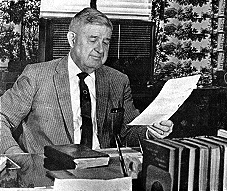
In 1940 tension between the two institutions exacerbated when the Bob Jones College Classic Players, the only college-based repertory in the nation, performed Shakespeare and Greek tragedy. Of course, BJC received pointed criticism from its Fundamentalist constituency. John R. RiceHowever, John R. Rice, editor of The Sword of the Lord, located in Wheaton, Illinois, defended the program, stating that “Shakespeare is great literature.” As with other subjects pertaining to the human experience, it was worthy of study. Again, the sharpest criticism was launched by Buswell, who had resisted drama at Wheaton College until his dismissal from its presidency in 1940, though students favored theatrical studies. Reviewing a 1949 sermon by Dr. Bob, Sr., Buswell, now serving as president of Shelton Bible College in New York, inquired: “…Let me ask you a question or two. Your own educational program is reeking with theatricals and grand opera, which lead young people, as I know, and as you ought to know, into a worldly life of sin.” John R. Rice published a three-page rebuttal in The Sword of the Lord, declaring that Buswell’s assertion was “utterly untrue.” In the years after Buswell left Wheaton, some classes were known to perform at least one short play, skit or pageant per week. Dr. Ed Hollatz, who completed his undergraduate degree at BJU and later served as professor of Speech and Communication at Wheaton, directed in 1966 Wheaton’s first “official” drama, Macbeth, inaugurating a series of successfully produced performances at Arena Theater. Stagings by others include Tartuffe, Medea, Murder in the Cathedral, The Crucible, Waiting for Godot and many more.
Since those early, steamy days, both Wheaton and Bob Jones University have enjoyed endless banquets of cultural offerings. Dr. Bob Jones, Jr., second president of the university, was an accomplished Shakespearean actor, approached by Hollywood and Broadway (refusing both), in addition to founding the largest Renaissance art collection in the western hemisphere. Similarly, Wheaton College, west of Chicago, boasts a world-renowned curriculum showcasing music, art, theater and writing, in addition to maintaining attractive, oft-visited campus museums featuring archaeological artifacts, British literature and American evangelism.

Other notable Wheaton College faculty who attended BJU include Robert E. Webber, late professor of Theology, Joseph McClatchey, late professor of English and Rolland Hein, retired professor of English.

Correspondence pertaining to the ideological complaints of Bob Jones, both Sr. and Jr., against the National Association of Evangelicals (SC-113) is maintained in Special Collections at Wheaton College.

(Much of the material for this entry is derived from Daniel L. Turner’s Standing Without Apology: The History of Bob Jones University, 2001)

In Search of a President

Louis TalbotWith the 1940 dismissal of Dr. J. Oliver Buswell from the presidency of Wheaton College, word spread quickly among conservative Christians that this rather important post was suddenly vacant. Shortly after Buswell’s departure, Dr. Louis Talbot, pastor of The Church of the Open Door in Los Angeles (founded by R.A. Torrey), received a wholly unexpected telegram from Wheaton College offering him its presidency. Excited about the possibility of leading the institution that had granted him an honorary doctorate in 1935, Talbot discussed the enticing prospect with trusted associates, including a bosom pal from Philadelphia.

As they chatted, Talbot’s friend realized that something was askew, so he asked about the city from which the message originated. Confirming suspicions, the telegram was sent from Canada, not Illinois. At that point both men realized that this was probably the plot of a mutual friend, Jim McGinley, a Canadian pastor known for hatching practical jokes. Turning the tables, Talbot phoned McGinley and announced that he had indeed chosen to accept Wheaton’s invitation, and would that very Sunday resign from his position as pastor. McGinley, horrified that the prank had gone too far, desperately tried convincing Talbot to please, please reconsider this hasty decision. But Talbot ignored Louis Talbothim and moved ahead, to the point of standing in the pulpit before his congregation, leaning dramatically into the microphone…only to announce matters entirely unrelated to resignation. Abashed but relieved, McGinley got the point.

Originally from Australia, Talbot graduated from Moody Bible Institute in 1913, and from 1915-17 served as pastor of Calvary Memorial Church in Oak Park, Illinois. His biography, For This I Was Born, appeared in 1977.

Talbot served as Biola’s second (1932-1935) and fourth president (1938-1952). Dr. J. Richard Chase, sixth president of Biola (Bible Institute of Los Angeles), founded by Lyman Stewart and T.C. Horton on February 25, 1908, assumed the office (for real) as the sixth president of Wheaton College in 1982.

Run Your Home Into The Ground!

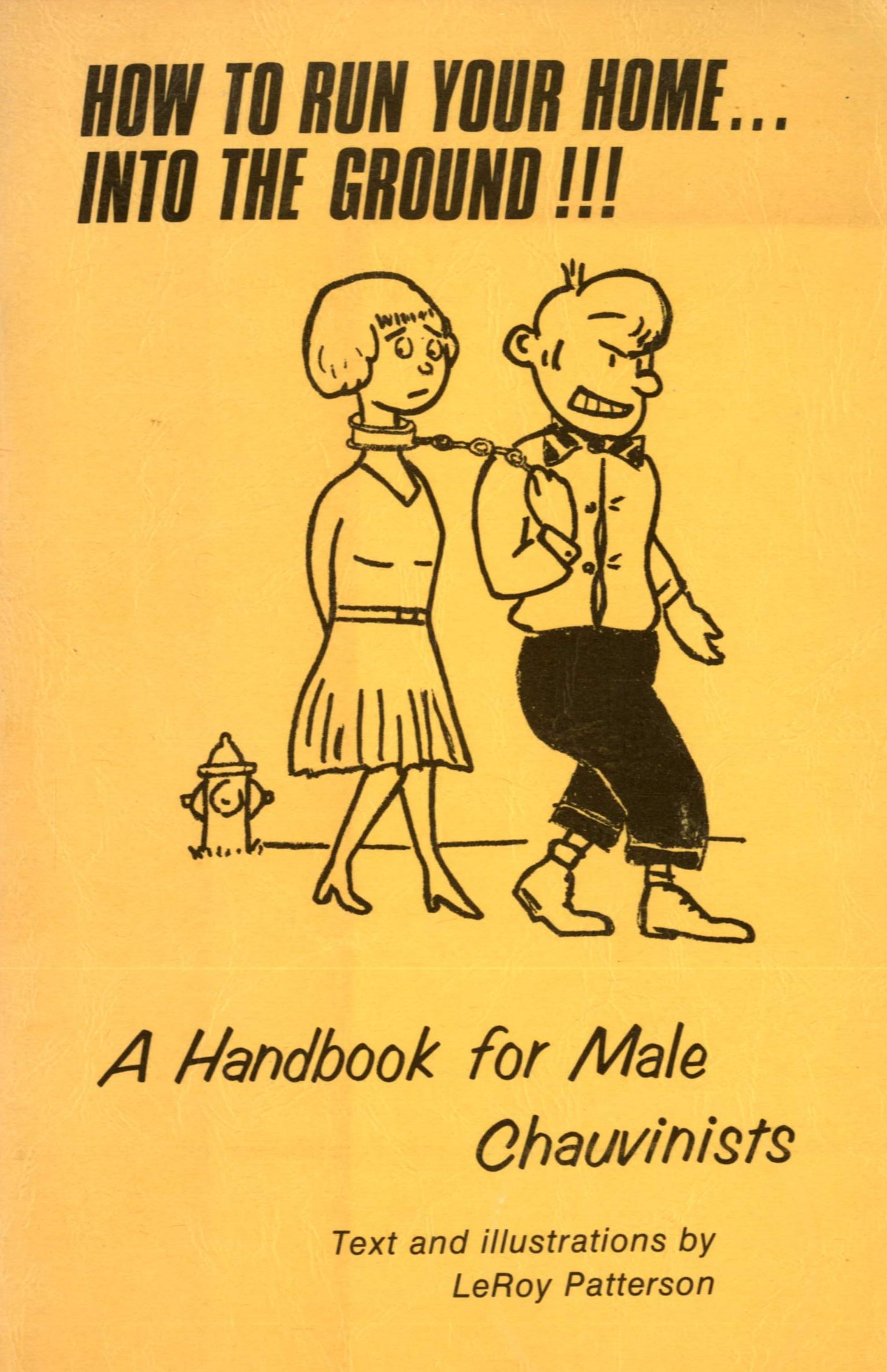
How to run your home into the ground

This evocative booklet was written by retired Wheaton College Chaplain, LeRoy “Pat” Patterson ’40. Penned in 1975 during the rise of the feminist movement, Patterson reflects on his 33 year marriage to his high school sweetheart and raising of three “fairly normal” children to highlight ten sure-fire ways to run your home into the ground.

  1. Let them know who is boss
  2. Never admit a mistake
  3. Throw the book at them
  4. Hold up the superior virtues of others
  5. Let them know what a martyr you are
  6. Never express affection outwardly
  7. Don’t spoil them with thanks
  8. Teach them to do as you say
  9. Children should be seen, not heard
  10. Religion is for women and children

At the conclusion of his tongue-in-cheek pamphlet, Patterson quotes from select passages from J.B. Phillips’ paraphrase of the New Testament.

“Husbands, love your wives, and be not bitter against them…Men ought to give their wives the love they naturally have for their own bodies. The love a man gives his wife is the extending of his love for himself to enfold her…let everyone of you who is a husband love his wife as her loves himself.”

Millions Served…

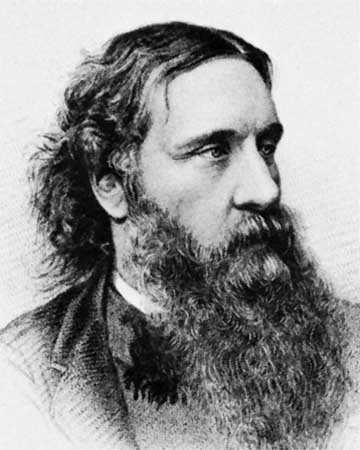
George MacDonaldGeorge MacDonald (1824-1905) was one of the most prolific and original of the Victorian novelists, composing a stunning array of novels, poetry and fairy tales, all laced with his singular Christian mysticism. C.S. Lewis regarded MacDonald as his “master,” declaring, “I know hardly any other writer who seems to be closer, or more continually close, to the Spirit of Christ Himself.” G.K. Chesterton cites MacDonald’s The Princess and the Goblin as a work that had “made a difference in my whole existence.” With Lewis, Chesterton and four other British authors, MacDonald’s life and work is featured in the Wade Center on the campus of Wheaton College. But he also figures in the spiritual development of three authors whose papers are collected in Special Collections, a separate archive from the Wade but also located at Wheaton.

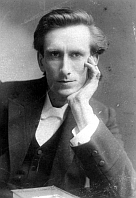
As a lonely child in New York City, novelist Madeleine L’Engle (SC-03) discovered the novels of MacDonald. She read them first for the story, then for the theology, responding with heartfelt sympathy to his emphasis on God’s love. In an essay titled “Nourishment for a Private World,” she declares, “Meeting George MacDonald’s writing when I was very young was a blessing to my understanding of God and creation and our own small but potentially beautiful place in it.”Oswald Chambers

Another keen admirer of the mystic Scot was Oswald Chambers (SC-122), who copied into his diary extensive passages from MacDonald’s books, not distinguishing George’s words from his own. After Chambers’s death, his widow, Biddy, prepared the notes for publication, not realizing that much of the material, so provocative and eloquent, may not have been original to Oswald.

MacDonald’s touch is also seen in a rather unexpected corner of the literary world. Visiting the Ernest Hemingway Museum in Oak Park, Illinois, you will see a display featuring a MacDonald poem called “Baby.” The poem meant much to the Hemingway family, and its pious sentiments surrounded the dedication of baby Ernest to a long, productive Christian life – which, sadly, did not occur. Ernest’s father, Anson (SC-209), attended Wheaton College, and was a friend of Jonathan Blanchard.

WHERE did you come from baby dear?
Out of the everywhere into here.
Where did you get those eyes so blue?
Out of the sky as I came through.

What makes the light in them sparkle and spin?
Some of the starry spikes left in.
Where did you get that little tear?
I found it waiting when I got here.

What makes your forehead so smooth and high?
A soft hand stroked it as I went by.
What makes your cheek like a warm white rose?
I saw something better than any one knows.

Whence that three-cornered smile of bliss?
Three angels gave me at once a kiss.
Where did you get this pearly ear?
God spoke, and it came out to hear.

Where did you get those arms and hands?
Love made itself into bonds and bands.
Feet, whence did you come, you darling things?
From the same box as the cherub’s wings.

How did they all just come to be you?
God thought about me, and so I grew.
But how did you come to us, you dear?
God thought about you, and so I am here.

Without doubt, through direct and indirect influence, MacDonald’s writings have influenced millions hungry for a taste of God’s tender mercies.

The Chrysostom Society

Artists often create in solitude, so it is not uncommon for these lonely souls to seek the company of other creative minds for encouragement, comfort and inspiration. For instance, author and lexicographer Samuel Johnson, portraitist Joshua Reynolds, historian Edward Gibbon, novelist Oliver Goldsmith and other 18th Century literary elite comprised “The Club,” assembling regularly for spirits and spirited conversation in London salons. Similarly in the 1930s, the “Inklings” of Oxford, England, gathered in a cozy pub where, amid swirling pipe smoke and raucous laughter, scholars such as J.R.R. Tolkien, C.S. Lewis and Charles Williams read their as-yet unpublished works, welcoming constructive scrutiny.

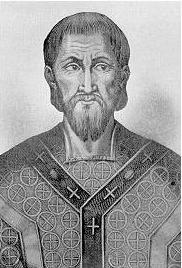
John ChrysostomThe tradition, now evangelically flavored, continues with “The Chrysostom Society,” named after the “golden-mouthed” third-century Church Father, reflecting his respect for words rightly used. Initially conceived as a Christian artists’ guild, the small collection of writers soon shifted emphasis, providing a wider arena for imaginative expression, expanding as it attracted interest. As Bible translator Eugene Peterson explains, “They felt it was really important to just get together, write together, and believe in each other as practitioners of a craft to the glory of God.”

Meeting informally at a rural retreat for four days annually, membership, though varying, caps at twenty. Organized in its early stages by Richard Foster, the Chrysostom Society’s roster includes Larry Woiwode, Calvin Miller, Eugene Peterson, Robert Siegel, Madeleine L’Engle, Stephen Lawhead, Harold Fickett, Diane Glancy, Jeanne Murray Walker, Phil Keaggy, Karen Mains and Gregory Wolfe. In addition to enjoying the refreshing pleasures of personal camaraderie, the Society occasionally collaborates on a manuscript. Their first work, Carnage at Christhaven (1989), is a comedic mystery based on a unique concept devised by the Detection Club of London, a coterie of crime novelists such as G.K. Chesteron, Agatha Christie, John Dickson Carr and others. For the Club’s corporate novel, The Floating Admiral (1931), participants each contributed a chapter, round-robin style.

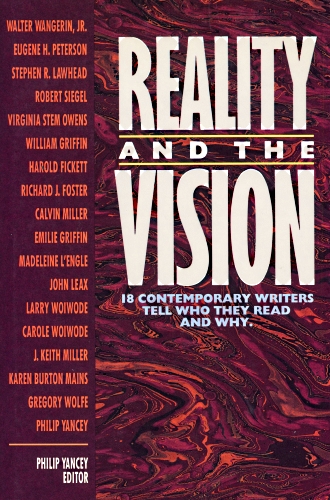
Reality and the VisionUsing this method for other publications, the Society then produced Once Upon a Christmas, a slim volume graced with colorful illustrations, assembling thoughtful seasonal memories interspersed with poems by Luci Shaw. In Reality and the Vision (1990), edited by Philip Yancey, the Society reflects on writers who influenced their own visions of the human condition: Walter Wangerin on Hans Christian Anderson; Larry Woiwode on Leo Tolstoy; John Leax on Thomas Merton, etc. The Swifty Tilting Worlds of Madeleine L’Engle (1998), edited by Luci Shaw, collects essays from members and other friends celebrating the 80th birthday of the beloved novelist. Among the Chrysostom Society, Wheaton College Special Collections possesses the papers of Luci Shaw, Madeleine L’Engle, Calvin Miller, Karen and David Mains and Robert Siegel.

Do Not Pass Go…

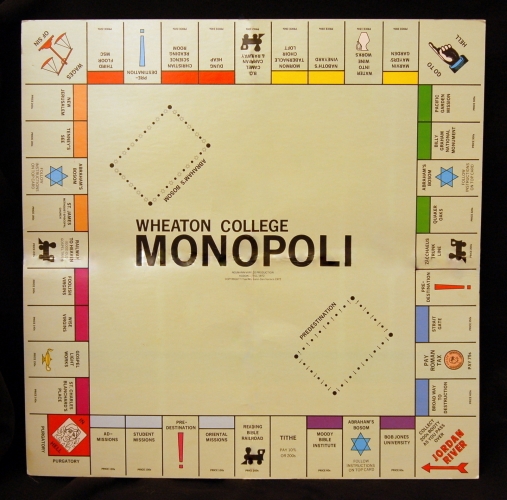
Monopoli

Wheaton College Monopoli was created in 1972 by the Kodon and Tower editors, Tim Neumann ’73 and Dan Varisco ’73. These two senior roommates who controlled most of the college printing power decided to collaborate their creative energies and produce a parody of the original Monopoly board game. According to Neumann the game was revised to reflect Wheaton’s spiritual heritage.

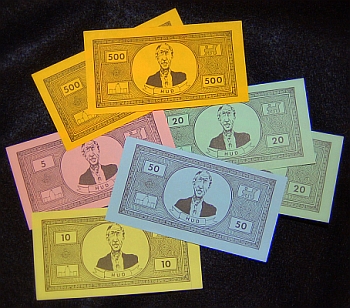
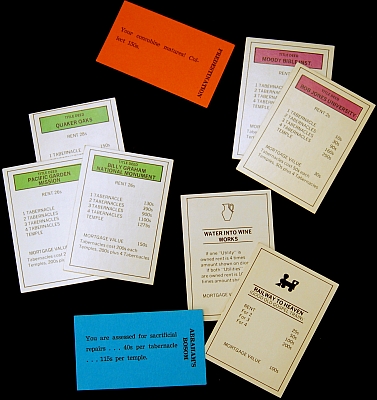
“Go to Jail” became “Go to Hell,” “Free Parking” became “Wages of Sin,” “Chance” cards became “Predestination” cards and “Community Chest” became “Abraham’s Bosom.” HUD MoneyPresident Hudson Armerding’s portrait appeared on the play money in the form of HUD bucks and Christian-controlled properties circled the board. The cheapest property, Mediterranean Avenue, was replaced by Bob Jones University, Water Works became “Water into Wine Works,” and North Carolina Avenue became Billy Graham National Monument in tribute to the famous alum’s home state.

In lieu of the customary literary magazine, a Monopoli game was produced for every student on campus.

Monopoli Cards

Although board games in general were never banned at Wheaton, President Armerding instructed that all copies of this game be destroyed due to threat of legal action from Parker Brothers. Parker Brothers has fought hard to retain the rights and trademark to Monopoly and has seen their efforts come to nought and be reversed several times, ultimately lobbying for a change to U.S. Trademark Laws to retain control of the brand. Decades later, this copy of the game surfaced from a retired member of the college’s administration.

Train of Thought

Chicago Transit AuthorityMany artists admit that motion stimulates creativity. A somewhat surprising source of imaginative inspiration is the Chicago Transit Authority (CTA). For many years it proved to be a dark but generous muse for Chester Gould, creator of the Dick Tracy comic strip. Each weekday Gould rode the train from his home in Woodstock, Illinois, to downtown Chicago where his office in Tribune Tower was located. Known for devising spectacularly nasty opposition for his square-peg hero, Gould frequently modeled his villains on the physical characteristics of the passengers sitting near him. One of his best-remembered baddies, Pruneface, was patterned after a horrifically scarred WWII vet. Other notorious mugs from Tracy’s Rogue’s Gallery were Flattop, Mrs. Prunface, the Brow, Pear Shape, the Mole and Little Face Finny.

Another proud graduate of the “CTA School of Artistic Expression” is Vinita Hampton Wright. Working as an editor at a Christian publishing house, Wright daily rode the train from her home in southside Hyde Park to suburban Wheaton. Already busy with various projects, she decided to use the travel time to finish her novel, Grace at Bender Springs (1999). After politely asking her usual commuting companions to ignore her as she concentrated, she opened her laptop and typed for the duration of the trip. When the book was published, she gave them free copies.

Metra CarReversing Wright’s trajectory was Dr. Ken Taylor. In the early 1960s Taylor rode the CTA from his Wheaton home into Chicago, where he served as Editorial Director of Moody Press. Desiring to produce a paraphrased Bible that appealed to young, modern eyes, Taylor, now concentrating on the Pauline epistles, set about performing his task during the morning journey. He writes: “…I sat with a Bible on one knee and a writing pad on the other. I tried to keep everything balanced and not let it fall over on my seatmate as he perused the morning paper.” And so, “…as the swaying train bumped along over the tracks,” he eventually completed The Living Bible, providing the foundational publication for the successful Tyndale House Publishers, international distributors of books, Bibles and videos.