All posts by admin

Haze-y Days of Wheaton

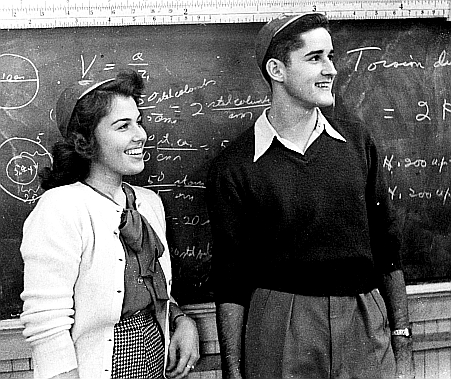
DinksAccording to the Oxford English Dictionary, Hazing is “a species of brutal horseplay practiced on freshmen at some American Colleges.” For nearly thirty years from the Pre-WWII era until the 1960’s, Wheaton College was no exception to this tradition. The rivalry between the incoming freshman and sophomore classes arose from parties thrown in the 1920’s to actually honor the freshman by the sophomores. In 1933 the Student Council approved “organized torture for the incoming classes.” The sophomore class would elect people to the “sophomore courts” which had the authority to summon freshman who were not following the rules. Punishment for failing to obey the regulations was originally twenty swats with a bare hand. However, as time went on, these punishments became less severe. Any freshman who did not participate in the system lost their privilege to be involved with class activities.

According to Freshman Hazing Rules listed in the Fall 1941 Record:

1. Dinks must be worn at all times except on Sunday and Friday evenings after 6:30 p.m.
2. Badges sold by the sophomore class must be worn at all times except Sunday and Friday evenings.
3. The following walks must not be used by freshman: between Williston and the Gym; between Williston and Blanchard; between Blanchard and the Gym; and the back entrance to the Stupe.
4. Keep off all grass on the entire campus.
5. At command “ATTENTION” given by a sophomore, the response is to simultaneously button with one hand and salute with the other and click the heels.
6. At command “BLITZKRIEG,” a white handkerchief knotted at each end, must be thrown in the air and caught on the head.
7. On Wednesdays, carry books in wastepaper basket. Boys will also carry whisk brooms and cloths to perform valet services for any upper classmen.
8. On Thursdays, both boys and girls must wear all clothes backwards, including dress shirts worn by boys. Walk backwards on campus. Girls’ hair must be in pigtails.
9. On Fridays, girls must wear one dress shoe with sock and one saddle shoe with stocking. Boys must wear clothes inside out, with one pant leg rolled to the knee.
10. On Saturdays, girls wear hair in curlers and war dresses and boys wear bow ties with crew neck shirts.
Carl Sandburg

Carl Sandburg (1878-1967), Illinois poet laureate, collector of songs and Pulitzer Prize-winning Lincoln biographer, resided in Elmhurst, Illinois, from 1919-30, writing for several Windy City newspapers, notably the legendary Chicago Daily News. After three productive, happy decades living in Illinois and Michigan, he moved in 1945 with his family to North Carolina where his wife, Paula, raised award-winning goats on their farm, “Connemara.” There he continued writing poetry and his one novel, Remembrance Rock, in addition to traveling the country, playing his guitar and singing American ballads. Renowned as both felicitious wordsmith and exhaustive researcher, he was hired by 20th Century Fox in 1961 to work on the script for director George Stevens’s biblical epic, The Greatest Story Ever Told. (Stevens also directed The Diary of Ann Frank.) The film, released in 1965, features Max von Sydow, Angela Lansbury, Shelly Winters, John Wayne, Roddy McDowell, Charlton Heston, Donald Pleasence, Sidney Poitier and Telly Savalas – truly an “all star cast.”

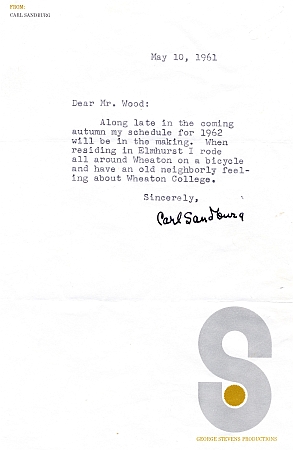
Sandburg letterWhile in Hollywood, Sandburg received an inquiry from a Mr. Wood, who evidently asked about the author’s relationship to Wheaton College. Typing on a sheet of “George Stevens Productions” letterhead, Sandburg responds on May 10, 1962: “Dear Mr. Wood: Along late in the coming autumn my schedule for 1962 will be in the making. When residing in Elmhurst I rode all around Wheaton on a bicycle and have an old neighborly feeling about Wheaton College. Sincerely, Carl Sandburg.”

Though Sandburg receives screen credit for “creative association,” his exact contribution to the project is not fully known. He received the job on the recommendation of Ray Bradbury, who declined the studio’s request that he write the script. Sandburg, born in Galesburg, Illinois, where Wheaton’s first president, Jonathan Blanchard, also served as president of Knox College, wrote in his autobiography, Always the Young Stranger, a rather unflattering portrait of the ever-crusading Blanchard, describing him as “…not one bigot but several.” He felt that Blanchard’s influence, which wasn’t cast in any positive sense, was present for decades after his departure, so much so that one could almost “catch the ghost of him.” To Sandburg Blanchard was the amalgam of a lion, bear and buffalo, and possibly half horse and half alligator!

Sandburg died in 1967. His ashes are interred beneath a boulder called “Remembrance Rock” in the backyard of his childhood home in Galesburg.

Josh McDowell

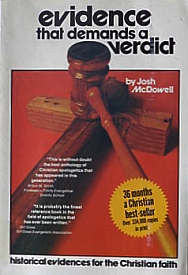
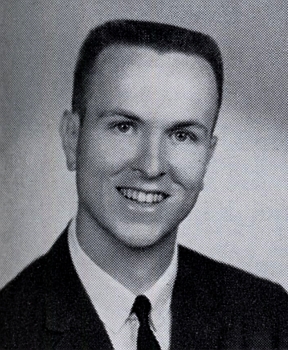
Josh McDowellIn 1960 a young man named Joslin “Josh” David McDowell transferred to Wheaton College from Kellogg, a community college in Michigan. His pastor had recommended the move. “Wheaton?” asked Josh. “Where’s that, Maryland?” Josh adjusted to Wheaton with some difficulty, his time fully occupied with studies or his house painting job. Advised by his pastor to gravitate toward the more pious students for fellowship, Josh did so, developing solid friendships with godly classmates, all eager to seek God’s face. One day as he waited at a crossing gate near campus, he noticed a car speeding up behind him. To his horror, the car – driven by a drunk – did not stop and barreled into him, pushing Josh’s vehicle onto the tracks at 45 mph. Fortunately Josh missed the path of the train. Though there was no visible injury, a sore neck indicated internal damage. Admitted to the college infirmary where he was confined to a cast and traction, he received a friendly visit from V. Raymond Edman, who stayed for two hours, praying with Josh. He later received a visit from Rev. Torrey Johnson, then-pastor of First Evangelical Free Church and founder (with Billy Graham) of Youth for Christ, who encouraged him in his desire to preach. After recovering, Josh and two friends met a visiting speaker named Bill Bright, founder of Campus Crusade for Christ. Joining the famous evangelist for coffee in the Stupe, Bright drew for them three circles with three thrones, each representing the kinds of people in the world, and who sits on their thrones: 1) the self-controlled unbeliever 2) the Christ-controlled Christian and 3) the carnal Christian. Josh then realized that he must endeavor to place Christ on the throne of his life. At that instant he entered a reinvigorated phase of evangelistic zeal, though he was still resistant to fully surrendering his life for service. Challenged by a “Spiritual Emphasis Week” message from Dr. Richard Halverson, Josh moved yet further toward yielding his will to Christ. That night, after late-night coffee at the Round the Clock cafe in downtown Wheaton, he walked Union Street in the cool, early hours of the morning, prayerfully struggling with the undeniable fact that God was beckoning, overwhelming Josh’s ambitions, calling him to a higher plane. Evidence that demand a verdictBut it was not until he discovered Bright’s “Four Spiritual Laws” among his notebooks that he discerned a distinct purpose and direction for his ministry; and so he finally committed to the Spirit-filled life. This provided the basis for his public ministry, wherein he would engage unbelievers through apologetic debates and exhort weak or undecided believers to pursue the same dynamic empowerment that had revolutionized his own life.

After Wheaton Josh attended Talbot Theological Seminary, graduating Magna Cum Laude with a Master of Divinity degree. In 1964 he joined the staff of Campus Crusade, preaching to thousands of students the world over; and in 1991 he founded Operation Carelift (now called Global Aid Network), one of the largest humanitarian aid organizations in the U.S. Among the 108 books he has authored or co-authored are Evidence that Demands a Verdict (1979), More than a Carpenter (1977) and The Last Christian Generation (2006). Still lecturing, he currently serves as president of Josh McDowell Ministries. His story, up to 1981, is told in Joe Musser’s Josh: The Excitement of the Unexpected.

Jesus Freaks

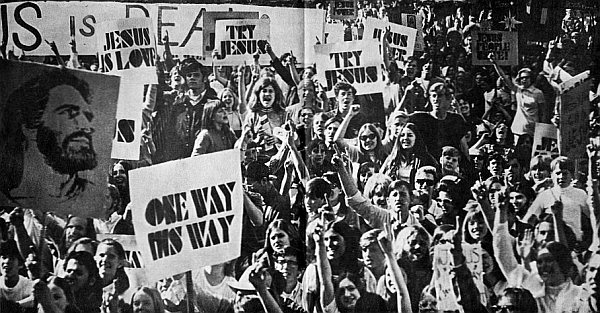
Jesus PeopleThe late 1960s and early 70s were years of tremendous ideological upheaval in the United States, not only in secular culture but also within the church. Christian youth, frustrated with staid worship and lifeless routine, longed for energetic, artistic expression. The Jesus Freaks were not seeking new content for their faith, but instead desired a re-packaging of traditional messages with brighter, hipper wrappings. An example is Larry Norman’s widely-popular song, I Wish We’d All Been Ready, its lyrics lamenting the absence of the unsaved in Heaven after the Rapture of 1 Thess. 4:16-17, the instantaneous “catching away” of Earth’s Christian population immediately preceding the worldwide Tribulation. Norman sets to music doctrines advanced in Hal Lindsey’s best-seller The Late Great Planet Earth (1970), which attempts to succinctly outline biblical end-time events from a premillennial perspective. Another influential text of this time-period is Kenneth Taylor’s Living Bible, a paraphrasing of the scriptures in modern idiom. Jesus PeopleIn his autobiography, My Life: A Guided Tour, Taylor expresses satisfaction that his work spoke to this audience: “These were the early days of the Jesus People Movement and, concurrently, the charismatic movement. One leader of the charismatics gave me his opinion that Living Psalms was one of the chief sources of nurture within the movement…This youth rebellion took some destructive and damaging forms, but at the same time it produced a sort of counterrevolution…Suddenly great numbers of young people in their late teens and twenties were turning to Christ for the answers they were so sincerely seeking…[They] were a receptive target for the fresh, up-to-date vocabulary and contemporary style of the Living version of the Bible.”

Recently an individual wrote to the Special Collections with appreciation for the influence of the Living Bible: “As a high schooler from 1970 to 1974, [Ken Taylor’s] Reach Out version of the Living Bible made a big difference in a lot of the young people of that era, me included. [H]is dedication to having the Bible in an easy to read format was so novel, so new, that it seems hard to believe now in the 21st century! So praise be to our Lord for using Mr. Taylor to bring the Good News to so many young, impressionable people who are now aging ‘young adults’!”

Lawson Field

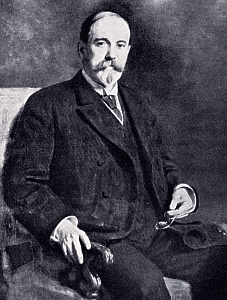
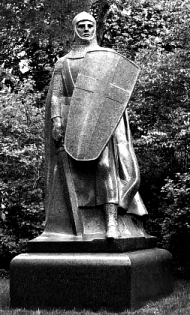
Victor LawsonThe tract of land called Lawson Field was the gift of Victor Fremont Lawson (1850-1925), friend of Wheaton College and proprietor of the Chicago Daily News — known as a publisher with a conscience. In 1900 when the field was dedicated, acreage, fencing and stands cost about $1500. For the following 90 years Lawson Field was the on-campus home of Wheaton baseball; it now functions as training grounds for various intramural sports programs. Another landmark named after the philanthropic publisher is the Lawson YMCA, a 25-storey art deco structure located at 30 W. Chicago Ave, erected in the early 1930s. The elegant River North edifice, once the flagship for the Metropolitan Chicago Y, was utilized from time to time as additional off-campus housing for Moody Bible Institute students. On the Southside, the University of Chicago’s Divinity School boasts Victor Lawson Tower, designed as a compromise between the classic church-style spire and traditional square-style educational architecture. The chapel’s windows are patterned after the stained-glass in Chartres Cathedral in France; and its cloisters display stones from Christian sites the world over. Lawson met his wife, Jessie, an aggressive real estate developer, in a church choir at Green Lake, WI. After honeymooning there in 1888, they purchased for their summer home 10 acres of land once occupied by Winnebago Indians and settlers. Initially calling it Lone Tree Farm, the Lawsons gradually added more properties until their vast estate, now called “Lawsonia,” comprised 1,100 acres. After the death of its owners, Lawsonia fell into various hands until the General Baptist Convention bought it in 1943 for $300,000. The GBC currently manages the grounds, known as Green Lake Conference Center. As a youngster Lawson attended Chicago’s first Norwegian Evangelical Church; as an adult he took active membership in The New England Church. During his career he was a generous contributor to the Congregational Missionary and Extension Society. A civic and ecclesiastical benefactor, Lawson’s kindness extended to the workplace as well. Historian John J. McPhaul writes in Deadlines & Monkeyshines: The Fabled World of Chicago Journalism, that the pious, fair-minded Lawson “…gave his staffers turkeys [at] Thanksgiving and Christmas.” Victor Lawson’s grave, located in Chicago’s famed Graceland Cemetery, is marked with a granite crusader bearing sword and shield, symbolizing his sacrificial, militant spirit. It was sculpted by Lorado Taft, who oversaw all stonework for the 1893 Columbian Exposition. Lawson’s papers are housed at the Newberry Library.

Embrace your inner-doodler

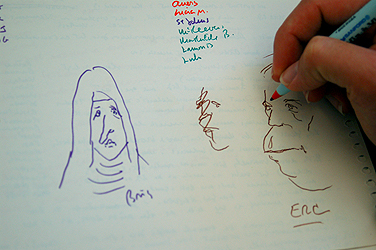
Buechner\'s doodlesBuechner, an inveterate doodler, writes nearly all of his works initially in long-hand. His papers contain book manuscripts, correspondence, articles, photographs, and published items. Recognized by Pulitzer Prize winner Annie Dillard as “one of our finest writers.” Buechner received an O. Henry Award – Third Prize (1955) and the Critic’s Choice Books Award (1990). Additionally, he has received honorary doctorates from Virginia Theological Seminary (1982); Lehigh University (1987); Cornell College (1989); Yale University (1990); and Wake Forest University (2000). Godric, dedicated to his father, was runner-up for the Pulitzer Prize in 1981. Brendan (1987) was nominated for the National Book Award. He has authored over thirty works of fiction and non-fiction. The papers of Frederick Buechner, author, lecturer and ordained Presbyterian minister, occupies approximately 55 linear feet.