All posts by admin

The Word For This Century

The Word For This Century, commissioned in 1959 by the Centennial Committee and edited by Dr. Merrill Tenney, Dean of the Graduate School, was published by Oxford University Press to celebrate the 100th anniversary of Wheaton College. In addition, it attempted to address the pressing question: “Has Evangelical Christianity a message for this era of tension and world conflict?” Containing essays based on the Wheaton College Statement of Faith by Carl F.H. Henry, Kenneth Kantzer, V. Raymond Edman, Billy Graham, John F. Walvoord and others, the book responds to the inquiry with confident affirmation. The preface, written by Tenney, follows:

Etched against the sky of a quiet Midwestern city, the tower of Wheaton College stands sentinel over the campus. For one hundred years Wheaton College has been a landmark of faith to its students who have chosen it as their Alma Mater, and to their parents and friends who have supported its ideals of Christian education. Under the leadership of four presidents, Jonathan Blanchard (1860-82), his son Charles Albert Blanchard (1882-1925), J. Oliver Buswell, Jr. (1926-40), and V. Raymond Edman (1940-65), Wheaton has maintained a consistent witness to Christian truth. Through numerous economic depressions, three major wars, and the shifting scenes of social and theological controversy, it has stood firmly for an undiluted Christian faith. Its faculty and graduates have been champions of political liberty, social reform, and evangelistic fervor. In 1937 the Graduate School of Theology was established as the result of a generous provision in the form of a residuary trust from the estate of John Dickey, Jr., of Philadelphia, in order that Wheaton’s ministry might be enlarged. Since the inception of the Graduate School more than three hundred and fifty alumni have been graduated and have entered the ranks of teaching, the ministry, and the mission field. This volume is issued on the centennial anniversary of Wheaton College as a testimony to its historic faith. The contributors of these essays, representing administration, faculty, and alumni, are actively engaged in preaching and teaching this message, and they speak for the larger number seeking to present the word of God to this century. As the list of authors on the title page of this book indicates it is the product of co-operative effort by men whose time is heavily taxed by the daily duties in which they are engaged. To them the Graduate School of Wheaton College is indebted for their contribution to this memorial volume. One of them, Dr. T. Leonard Lewis, the President of Gordon College, was suddenly taken to be with the Lord in the spring of this year, and the chapter that he wrote is one of the last products of his pen. To all of these men hearty thanks are due for their willing participation. Special thanks are offered to Dr. Carl F. H. Henry and to his publisher, Wm. B. Eerdmans Publishing Company, for permission to quote two paragraphs from his Christian Personal Ethics. The Centennial Committee of Wheaton College, Richard Gerig, Chairman, has aided materially in sponsoring this project. The Editor acknowledges gratefully the help of his wife, Helen J. Tenney, in preparing the manuscript for publication, and the stenographic work of Mrs. Edward A. Adams in the transcription of the copy.

History’s Lesson for the Ages

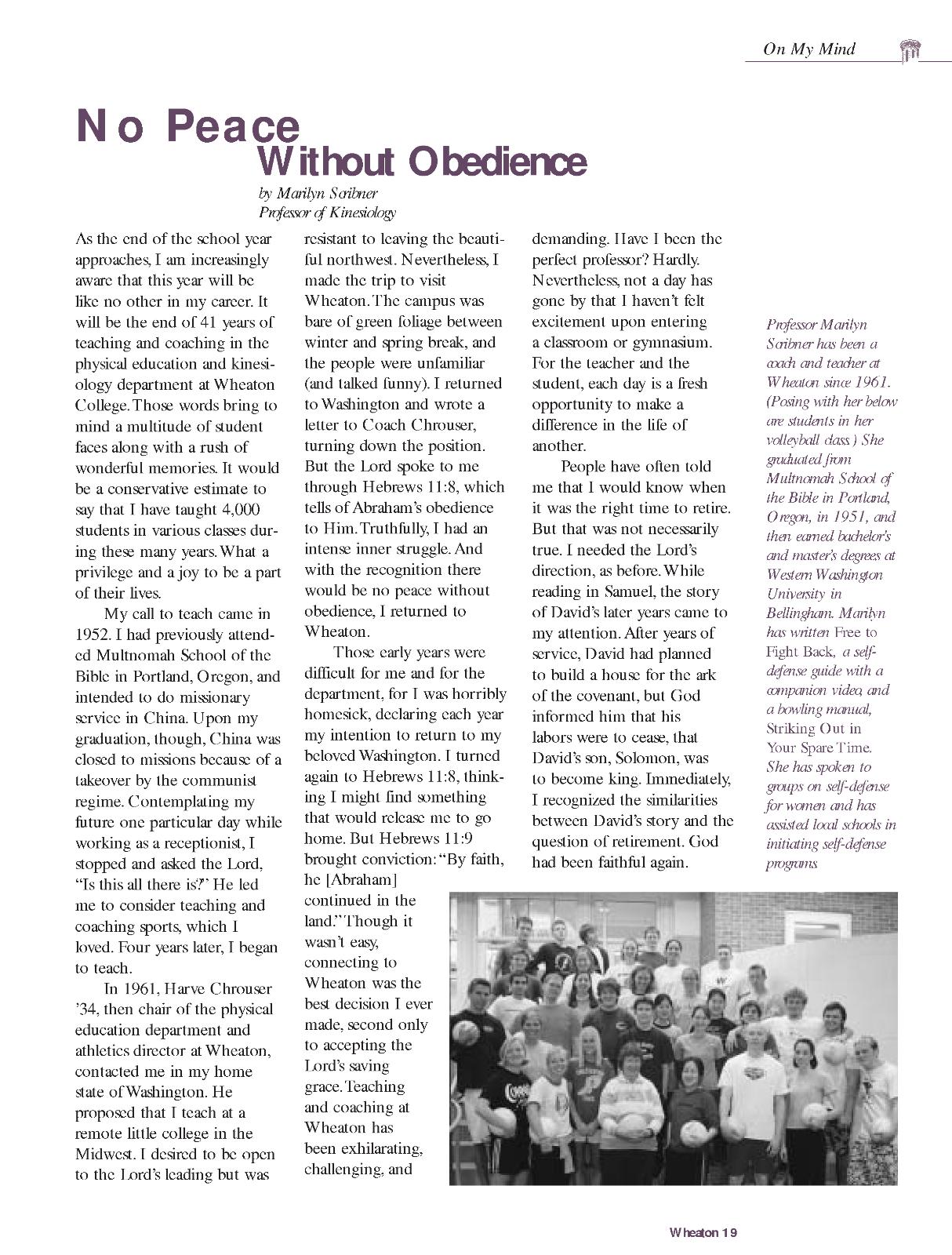
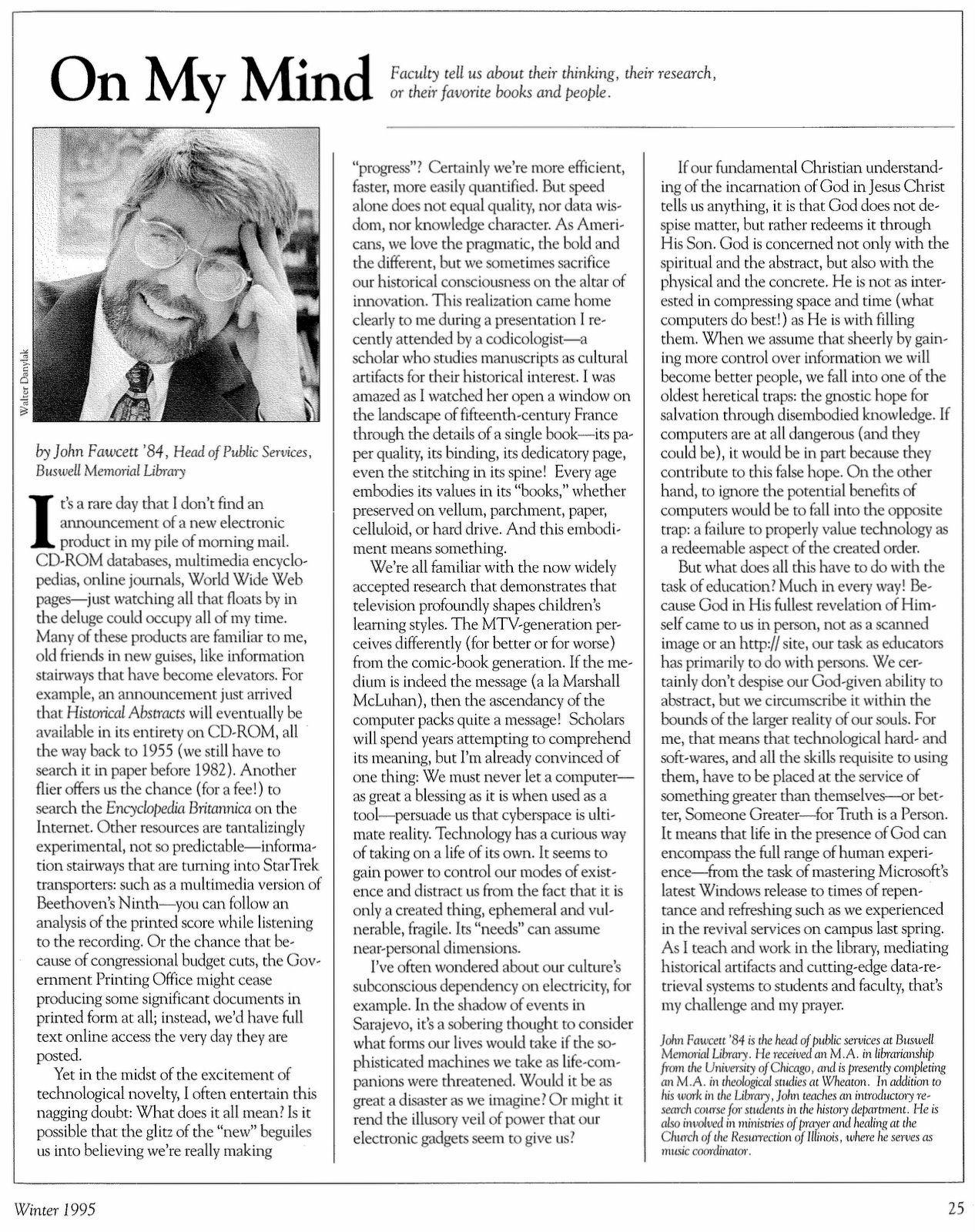
Over twenty years ago, the Wheaton Alumni magazine began a series of articles, titled “On My Mind”, in which Wheaton faculty told about their thinking, their research, or their favorite books and people. Associate Professor of History Emeritus Thomas Kay (who taught at Wheaton from 1959-2004) was featured in the Spring 2003 issue.

Historians are often asked, “What does history teach?” Such an inquiry suggests that history is a measure by which we might evaluate the present and project the future; it makes the past absolute, definitive, and normative. Hence,”Whatever was, was right.” Thereby, the past serves as window both to the present and also to the future. The historian becomes both pundit and prophet.

My response to such queries is always, “History teaches change.” Each unique historical event may provide an understanding of the past, the present, and perhaps a glimpse into the future, which is not to say that the past determines the present or the future.

Sages of ancient Greece and Rome sought to discover in history the element of a balanced and complete social and political structure that could be implemented for all time. From those elements one might develop the best of human associations, perfecting their members and possessing eternality. Their efforts and formulae for well-intended reform and renewal broke down under their own weight and a failure to grasp the character of the fundamental human condition–sin. Self-interest, personal gain, and power undercut the search for peace, stability, order, and community. The laws of the jungle became the master.

The advent of Jesus Christ came when many aspects of the Roman Empire and classical civilization were giving way. Even in the glow of the cessation of civil strife and the popular hope that Augustus Caesar would be harbinger of peace and a new, enduring order, the rule of the stronger continued. In the midst of grasping, praying, and hoping for political, economic, social, and moral stability there were many changes. Rome fell prey to the whims and desires of leaders bound by their personal goals of power, self-glorification, and deification. That for which Rome yearned–peace, order, eternality–would not come through changes wrought by sheer power, even by those who exemplified the highest classical values. Such change came and continues to come to every person in the advent (past, present, and future) of Jesus Christ, whose eternal kingdom, the City of God, transforms the human experience now and forever.

As throughout history, life has always been, and will continue to be full of changes. There are the changes of birth, growth, and death; the changes in human relationships and changes of residence, work-place, and martial status.

Ironically, the essence of Christianity is also change. There is the change of becoming a new creation in Christ and the ultimate change that will mark the denouement of history: “In a moment in a twinkling of an eye, we shall all be changed” (1 Cor. 15:52). It is only after history is finished that non-change becomes fully possible; in that place where there is no day nor night, no tears, no illness and no death.

History teaches change and coping with change. This is the human predicament. Change is only transcended by both the temporal and eternal foundations of the City of God. It is this for which all humanity has sought, and will continue to seek throughout the ages.

———-

The following statement was included at the time of publication: Dr. Thomas Kay has been professor of history at Wheaton for 44 years and served as coordinator of the interdisciplinary studies major for 14. He received his master’s and doctoral degrees from the University of Chicago and serves on many load and state historical society boards including chairing the Illinois State Historical Society Symposium this year Dr. Kay’s current projects include a history of College Church in Wheaton, where he represents the middle of five generations of family attending. Dr. Kay and his wife Janice have three children and seven grandchildren, including two sets of “grand twins.”

Wheaton College and Quarryville Presbyterian Home

Lancaster County, Pennsylvania, boasts a singularly rich Christian heritage, dating to the founding of the country. Closely associated with Amish, Mennonite and Quaker settlements, this district also enjoys the presence of Quarryville Presbyterian Home, founded by Franklin S. Dyrness. Graduating in 1931 from Wheaton College, Dyrness enrolled at Westminster Theological Seminary. Later serving as a pastor in Pennsylvania, he attempted locating housing for several elderly women from his congregation. Finding nothing suitable, he decided to establish his own home, but this one would be different. “We’re here not here just to have people take care of old people,” he told an interviewer. “I’m not interested in that. Let the government do it. We’re here with Christian concern in action. The Lord has led them here, and they have come of their own accord. People say that you ought to be happy that you established this. I say, please don’t say that. I have no credit. I don’t want any. The Lord is the only man who can do it and he did. Therefore, give God all the honor and praise.” While studying at Wheaton College Dyrness met his wife, Dorothy (“Dot”) Ruth Rasmussen. Franklin’s brother, Enock Dyrness, acted as the college Registrar from 1924-69.

Quarryville is tied to Wheaton College in other significant ways, as well. Throughout the years, many staff and alumni have retired here, notably Katharine Tiffany, longtime English teacher, who called it “the Conrad Hilton of retirement homes.” A room at the Home was named after her, the K.B. Tiffany Memorial Center. Dr. J. Oliver Buswell, third president of Wheaton College, lived his final years at Quarryville. Unlike his successor, V. Raymond Edman, who died of a heart attack quite publicly while preaching a chapel message at Wheaton College, Buswell simply slumped in his wheelchair, passing quietly. He is buried in Quarryville Cemetery. Wheaton’s fifth president, Dr. Hudson Armerding, spent several retirement years at Quarryville, assisting the chaplain with preaching and room-to-room visitation, before returning to Wheaton shortly preceding his death in 2009.

Franklin Dyrness served as president of Quarryville Presbyterian Home from its 1948 inception until his retirement in 1985. He was elected to the Wheaton College Honor Society and was bestowed the Doctor of Divinity in 1960. The Home and his alma mater contributed funds to establish the Franklin S. Dyrness Chair of Biblical Studies at Wheaton College. He was also president of the Board of Trustees of The Reformed Presbyterian Church in North America. According to his son, F. Seth, Jr: “We gathered around his bed and sang some of his favorite hymns for him. As we sang the final verse of Rock of Ages, he closed his eyes and went to be with the Lord. It was beautiful and deeply comforting for us as a family.” Franklin Dyrness died on June 16, 1990.

New Book on Evangelical Left Published

A newly released book by Wheaton College graduate, David Swartz is receiving favorable reviews by scholars and critics alike. Significant research was conducted in the Sojourners Records and other archival resources of the Archives & Special Collections prior to publication of Moral Minority: The Evangelical Left in an Age of Conservatism (University of Pennsylvania Press). Dr. David R. Swartz is an assistant professor of history at Asbury University. He earned his Ph.D. in American history at the University of Notre Dame under the direction of George Marsden and Mark Noll. Areas of expertise and teaching interest include American religious history, twentieth-century American politics, global religion, and issues of war and peace.

According to the book’s website, “Moral Minority charts the rise and fall of a forgotten movement: the evangelical left. Emerging in an era when it was unclear where the majority of evangelicals might emerge politically, the evangelical left held great potential. The convergence of civil rights and antiwar activism, intentional communities, and third-world evangelicals in the early 1970s prompted the Washington Post to suggest that the new movement might ‘launch a movement that could shake both political and religious life in America.’

In the end, it did not. Moral Minority charts how identity politics roiled the evangelical left–and how the Democratic Party in the 1970s and the religious right in the 1980s left progressive evangelicals behind. The failure of the evangelical left, thus, was the product of a particular political moment more than a reflection of evangelicalism’s inherent conservatism. As a new century dawns, Swartz suggests that this marginalized movement could rise again, particularly if the Democratic Party reaches out to evangelicals and if Christian immigrants from the Global South are able to reshape American evangelicalism.”

According to the New York Times:

“Moral Majority is a vivid topography of a little-understood corner of evangelical thought. It is not an account of a political movement–because there was no movement to speak of. This is a story of failures and might-have-beens, but it is just as illuminating as a history of political success.”

Dr. William Leslie and LaSalle Street Church

Located halfway on the mile between Chicago’s Moody Bible Institute and Moody Memorial Church stands LaSalle Street Church, its 130-year old spire tucked snugly amid a row of upscale condominiums, only two blocks from Lake Michigan. But when William Leslie left his position in 1961 as assistant pastor of Moody Church, serving under Dr. Alan Redpath, to lead the struggling assembly, the district was severely blighted, collapsing beneath the weight of decrepitude, poverty and racial tensions. Leslie, a graduate of Wheaton College, realized that he must not only preach to touch the spirit, but he must also address the material welfare of his parish.

And so, operating under the motto, “The Whole Gospel for the Whole Person,” LaSalle Street Church instituted a tutoring program, eventually gathering over 300 students. Soon other ministries blossomed. LaSalle Street Young Life recruited men from gangs, providing alternatives in Bible studies, sports and summer camp. LaSalle Street Senior Center provided meals, counseling and exercise for the Northside elderly. The Cabrini-Green Legal Aid Counsel sought justice for the ill-served, offering legal aid. Bridging was established to assist single pregnant women, offering an alternative to abortion. These programs not only fulfilled Leslie’s desire to mobilize his strategically-placed church, rather than allowing the members to sit passively, but strengthened LaSalle Street’s purpose to holistically worship, educate and evangelize. Another vital component was the incorporation of the arts, drawing heavily from the talents of gifted members. Plays, banners, slide shows and dance were all used to enhance worship and brighten the sanctuary. As a result of these innovations, Leslie was known to his congregation as “the resident dreamer.” Busloads of students from Wheaton College arrived weekly to assist with the various ministries.

Dr. William Leslie died of a heart attack at age 61 in 1993. Writer Philip Yancey, longtime member of LaSalle Street Church, wrote a memorial published in Christianity Today:

Bill Leslie was a most unlikely pioneer. He was disheveled, disorganized (several times I waited in vain for Bill, who had forgotten our appointment or gone to the wrong restaurant), and hardly a promising candidate for racial reconciliation. (He had attended the strictly segregated Bob Jones University, and his father-in-law had worked in racist Lester Maddox’s gubernatorial campaign.) Yet he, as much as anyone, was responsible for pointing the evangelical church back to the city and for reminding us that Jesus came to redeem communities as well as individual souls.

The story of LaSalle Street Church is related in The Church That Takes on Trouble (1976), by James and Marti Hefley; it is also the subject of the film, “The Heart Cannot Run.” In 1992 the City of Chicago cited Leslie in the 1993 “Who’s Who in Religion,” commending to him its “deepest and most sincere gratitude for all [he] has done to improve the community, and to better the lives of the citizens of the City of Chicago.”

Leslie’s papers (SC-75), comprising correspondence, photographs and cassettes, are archived at Wheaton College Special Collections, available to researchers.

Banners of Truth

Treasures of all shapes, sizes and shades, from manuscripts to memorabilia, are maintained in the Wheaton College Archives & Special Collections. Most materials are housed in a restricted climate controlled storage facility, but a few are displayed in the public area. Among the more colorful artifacts exhibited are the pink, red and purple liturgical banners hanging above the microfilm cabinets in the back corner of the reading room. Designed and crafted by artist Marjorie Geiser, the banners hung for years in the Bible Seminar Room in the Graduate School. The wall hangings and other renovations were implemented as a memorial to Jean Kennedy, who with her husband, Ted, established the B.H. Kennedy Memorial Scholarship Fund in the Graduate School.

Marjorie Geiser explains the symbology of her banners to Dr. Richard Chase, President of Wheaton College

Calvin Miller and the Unfinished Business of Earth

Calvin Miller, author, pastor and professor, died on August 19, 2012. He was 75. His first book, The Singer, published by IVP in 1975, is a poetic, colorful retelling of the life of Christ, flavored with dashes of Milton and Tolkien. In the following years he produced a nonstop flow of novels, non-fiction, apologetics and a memoir, Life is Mostly Edges. His final book, Letters to Heaven, is a series of letters written by Miller, a late-life nod to the now-deceased men and women who positively touched his life, some of whom he’d met, others complete strangers. He begins with this bit of verse:

How shall I finish up the unfinished business of earth?

Letters, I think.

Each of you who will receive these letters is dead

at least in this realm

and I am counting on some courier

whose form of delivery I do not know

to get these words through to you.

Composing 26 entries, he cites individuals from personal and professional spheres, including members from his former pastorate, Westside Baptist in Omaha. He recalls Sophie Smithson, whom he “never much liked” because of her scowling aspect and relentlessly critical spirit. Nonetheless, she provided a beautiful foil to her husband, John, whose patience and abundant kindness demonstrate to Miller the binding strength of the marriage vow: For better, for worse, ’til death do us part.

He expresses appreciation for better-known Christians such as Norman Vincent Peale who “taught me effective pulpit communication,” and C.S. Lewis, whose struggle with doubt in A Grief Observed leaves a somewhat sour taste in his mouth. “Maybe [in Heaven],” writes Miller, “in better light, you will display the customary optimism about God that so marked your life.”

A particularly interesting and somewhat surprising entry is actress Farrah Fawcett, at whose home Miller and his family enjoyed Thanksgiving dinner in 1969, just before she became famous. He recognizes her career-long understanding that “beauty is more than skin deep; it is soul deep.”

Sprinkled throughout Letters to Heaven are several names associated with Wheaton College, whether alumni or donors. For example, he thanks missionary martyr Jim Elliot, the “crisis man” whose dedication forced men to “turn one way or another on facing Christ in me.” Miller writes, “My whole life was redeemed by your counsel.” Miller thanks 911 hero Todd Beamer. “The hero you never meant to be became a legend in the world you had to leave.” Again discussing the matter of matrimony, Miller thanks author Madeleine L’Engle, with whom he was a member of the Chrysostom Society, for her strong, long marriage to Hugh Franklin – and her steady continuation with life after his death to cancer. He thanks publisher Harold Shaw, meeting him but once for dinner in 1975 with Luci, “…your dear wife and my only important poetic fan in the beginning…” The Shaws encouraged Miller to continue writing after the publication of The Singer, pushing ever forward.

Now that Calvin Miller has joined the subjects profiled in this book, readers may consider his generous writing, ripe with humor, hard-won wisdom and sanctified imagination, as letters from Heaven addressed to those yet confined to Earth, awaiting passage.

The papers of Calvin Miller (SC-24), Luci Shaw (SC-46) and Madeleine L’Engle (SC-03) are archived in the Wheaton College Special Collections.

The Museum of Lost Wonder

The field of archival science is abundant with manuals, academic courses and web seminars. Though most educational materials deal with the technical specifics of processing and preserving historical items, whether it be manuscript, media or artifact, few books address the more intangible aspect of the researcher’s personal response. How does this item effect my life? What feelings or thoughts does it stir? A notable exception to this is The Museum of Lost Wonder (2006) by Jeff Hoke, previously a curator at the Field Museum in Chicago, now the Senior Exhibit Designer at the Monterey Bay Aquarium in Monterey, California. Hoke’s book is not Evangelical, but it is deeply spiritual, utilizing alchemical motifs as it explores the analogy between the imaginary Museum of Lost Wonder, with its seven enigmatic exhibit halls, and the development of the human soul. One reviewer says that Hoke’s Museum is “…a metaphysical architectural model of the mind, a kind of cornucopia of hermetic knowledge.” Another calls it “…a soulful delight – an alchemical workbook designed to remap the connections between science and poetry, matter and psyche, philosophy and comic books.”

The grand tour begins with this exhortation:

I created the Museum of Lost Wonder as a storehouse for weathered memories so the wonder they engender doesn’t get lost. It’s a place to collect all the nagging, hard-to-answer questions we’ve had since childhood. The Museum of Lost Wonder isn’t a place of answers – like wonder, answers are always personal…The Museum of Lost Wonder is not a collection of objects, but rather a place to collect ideas and explore the meaning of your own experiences. We take inspiration from the original museums and curiosity cabinets of of the 1600s. Unlike modern museums that try to separate fact from fancy, the Museum of Lost Wonder encourages you to join these seemingly disparate ways of looking at things so you can decide what’s meaningful.

Incorporating a few of these intriguing concepts, the Wheaton College Archives and Special Collections also desires that visitors and researchers to its various holdings and exhibits will discover similar stirrings in their hearts, hopefully aspiring to greater heights of Christian faithfulness and consecration.

Willis Hugh Cork, 1896-1918

As the wars in Iraq and Afghanistan continue, it is appropriate to pause and remember our fallen soldiers, not only those of the present, but also those of the past. A statue of a doughboy, representing U.S. troops killed during WW I, stands in Memorial Park in downtown Wheaton. Other memorials situated in public spaces around the city commemorate the ultimate sacrifice of our Armed Forces.

The first resident of the City of Wheaton to die during WW I was Norman James Tweedie, but the first Wheaton College students to perish were Russell R. Brooks and Willis Hugh Cork.

A memorial to Cork in the Wheaton College Record declares:

It is not task to bring a rich and sincere tribute to the memory of Willis Cork, who passed away the morning of Oct 2, for memory brings a richer and fuller tribute than mere words can ever express. The past year had been hard for Willis who since the first of last summer had been patiently and persistently trying to get into some branch of the service, so we man feel sure that the last two weeks held a deep happiness for him in the realization that he was at last an active part of that cause for which he was to make the ultimate sacrifice. As a student he was thorough, in business reliable, and with all he was one of those lovable people who win and hold the affection of all who come into contact with them. It seems hard to realize that the charm of his sunny smile and rare good will are gone from us, but for Willis Cork, athlete, student, soldier and Christian, the change is a glorious one and in his own words, “God’s will is best.”

Judge Frank Herrick, Wheaton’s official poet laureate, composed this verse honoring Cork:

We loved him for his sunny soul,
His clean life day by day,
His zeal that would not brook control
To join the worldwide fray!

The sunlight hidden in his heart
Shone in his genial face
Revealing an unconscious art
His wealth of inward grace.

We saw him don the khaki suit
That soon became his shroud
And wear it brave and resolute
With happy heart and proud!

Death has paled the shining star
And dimmed the eager glance
That with longing saw afar
The flaming fields of France!

Farewell, hero-heart that beat
Sweet music strong and brave.
Thine is the sacrifice complete
That Freedom’s flag may wave!

A Tale of Two Clocks

Twenty years ago, the Wheaton Alumni magazine began a series of articles, titled “On My Mind”, in which Wheaton faculty told about their thinking, their research, or their favorite books and people. Professor of German Emerita Carol Joyce Kraft (who taught at Wheaton from 1960-1996) was featured in the Autumn 1995 issue.

There are two clocks in my office. One hangs on my wall and is powered by a battery. The other stands on my desk and needs winding every day.

Even though I sit between the two, when my mind is on course work, that mound of detailed mental activity calling loudly for attention, I hear the small clock. Ticktickticktick.

During those times when someone has come to the office to speak of personal matters, the pace is slower and more relaxed. We listen to each other, and somewhere in the midst of that discussion I have noticed that I always hear the slower clock. Tick…tick…tick…tick…. The other clock, the one that suggests a frantic pace, seems to have disappeared.

Two clocks. Why do I mention them? For the past few years in our twentieth century German literature course we have read and discussed some themes in the recent work, Momo, by Michael Ende. This is a modern fairy tail for adults, one which remained on Germany’s best-seller list for many months in 1983.

What was it that drew so many readers? Could it be that they saw themselves in that skillfully drawn reflection of modern life?

Momo is the story of a young orphan girl who listens to people. She is one who gives all who will come that valuable gift of rapt attention.

We soon notice, however, that there are gray figures who have appeared in the city. They are everywhere and they all look alike: gray coats, gray hats, gray briefcases, gray cars, ashen gray faces, As we listen in on one, we discover that he is trying to persuade a barber that it would really be to his advantage to save more time. He begins to list all the things that Herr Fusi, the barber, does when he is away from his shop. He eats, he sleeps, he visits his deaf mother daily, he cleans his house, he reads, he spends time with friends, he sings in a choir, he visits a crippled young girl, and he even spends 15 minutes at the end of his day meditating over what has transpired since the morning began.

All this time is lost, misspent, useless, says der Graue. Why it’s about half of your life, Herr Fusi! The solution? Zeitsparen. You have to save time. How do you do that? Work faster, Herr Fusi! Omit the “extras.” The time that you save, we’ll put in the savings bank, with interest. The amount you save will double every five years! We don’t force anyone, mind you, but it’s really to your advantage. Think about it. Time is money.

Herr Fusi thinks about it. He decides. It is as though he is compelled to speed up his work. And we watch him very gradually become less than a Mensch, less than a human being. He becomes a machine. And so do his friends. And most everyone else in the city. They become hardly recognizable anymore. They have no time to think. No time to listen. No time for the heart. No time for the family. No time to be. Robots are what they have become. The tragedy is that they don’t know it; they don’t recognize what they have become; or if they begin to realize what has happened, they see no way out. They find themselves trapped in their frenzy. The more time they save, the less they have. They have been trapped by a lie.

What an image!

It is the children in the story who see clearly that something is amiss in the world of grown-ups. It is the children, through Momo, who bring sanity back to the city. It is the children who restore a healthy sense of time. They recognize that time is not money. They know that time is a matter of the heart. (The remainder of the story I will leave for your reading.)

Although I don’t agree with one of the main thoughts, that time is everything, I do agree with the author’s main thrust, that time cannot be “saved” for later. Time is for now. It is precious and it is only used once. The more time we save, the less we really have.

So, ours also is a world of clocks. Which one is it that we hear? The one with the frantic pace or the one that allows us pauses to live?

I chose this topic of time because there are moments in the classroom when I am reminded that James (3:1) was right when he reminds us that not many should become teachers. It is an overwhelmingly humbling experience when you sense that someone has acted on the suggestions you have made. So what is it that we are reflecting, by our words, by our lives, by the way we make use of our time?

———-
The following statement was included at the time of publication: Carol J. Kraft ’57 received the B. A. from Wheaton, an M A. in the Teaching of Foreign Languages front Teacher’s College, Columbia University, and an M .A. in Germanic Language and Literature from the University of Michigan. She took additional graduate study at Middlebury College and has participated in several summer programs in the Goethe Institute in Germany. She has served as a member of the Foreign Language Department since 1960. Another strong area of interest is that of Spiritual Direction, which is a part of her responsibilities as ordained deacon in the Episcopal Church, Diocese of Chicago, serving at St. Barnabas’ in Glen Ellyn.